


Train Accident Lawyers Handling Commuter Accidents, Derailments and More
What Should I Do Immediately After a Train Accident?
Immediately after a train accident, you should have two priorities: (i) getting the medical attention you need, and (ii) talking to a lawyer about your legal rights. If you are able to do so, you should also record as many details as you can remember. Once you have received all necessary emergency medical care, you should follow your doctor’s advice (or seek a second opinion), and you should hire a lawyer to conduct a comprehensive investigation.
How Long Do I Have to File a Train Accident Lawsuit in Illinois?
How long you have to file a train accident lawsuit in Illinois depends on the entity that owns the train involved in the accident. If you have a claim against a private railroad company, you may have up to two years to sue. However, if you have a claim against a government agency, the deadline to file could come much sooner.
With that said, in all cases, it is important to take legal action as soon as possible. Once you hire a Chicago train accident lawyer to represent you, your lawyer will be able to get to work immediately, gathering critical evidence and fighting for the compensation you deserve.
Can I File a Claim If I Was Injured as a Train Passenger?
Injured train passengers can file claims in various circumstances. If you were injured as a train passenger under any circumstances, it will be well worth talking to a lawyer about your legal rights. If you have grounds to file a lawsuit, an experienced Chicago train accident lawyer will be able to help you seek just compensation for your medical bills, lost earnings, pain and suffering, and other financial and non-financial losses.
Can Pedestrians Injured by Trains File a Lawsuit?
Pedestrians injured by trains can file lawsuits in many circumstances as well. Here too, it will be important to promptly consult with a lawyer about your legal rights. Even if you have clear grounds to file a lawsuit, it is up to you to protect your legal rights, and gathering forensic evidence at the accident scene is a key first step in the process.
What Evidence Is Important in a Train Accident Case?
Train accident cases can involve numerous forms of evidence. Along with forensic evidence from the accident scene, this may include eyewitness testimony, expert reports and testimony, traffic or surveillance camera footage, cell phone photos and videos, the train operator’s internal records, and the train conductor’s phone records, among many other forms of documentation.
Filing a successful train accident case also requires evidence of the losses you are entitled to recover. In a typical case, this will include your medical records and bills, your employment records, your account statements and receipts, and documentation of your non-financial losses.
Can Multiple Parties Be Liable for a Train Accident?
Multiple parties can share liability for a train accident—and this is not uncommon. Train accident cases can involve claims against the train operator, the owner of the railroad, the train’s manufacturer, maintenance and repair providers, negligent drivers, and various other parties. If you have grounds to file a train accident lawsuit in Chicago, identifying all liable parties could be critical for seeking the full compensation you deserve.
What If the Railroad Company Denies Responsibility?
Railroad companies routinely deny responsibility for serious and fatal accidents. If the railroad company denies responsibility for your accident (or your loved one’s accident), you should not accept this as the final word on your case. Once you hire an experienced Chicago train accident lawyer to represent you, your lawyer will be able to accurately assess liability and then advise you with your best interests in mind.
Should I Speak with the Railroad's Insurance Company?
While seeking compensation for a train accident often involves dealing with the railroad’s insurance company, we strongly recommend that you do not speak with the railroad’s insurance company yourself. Instead, you should rely on your lawyer to handle all communications on your behalf. The railroad’s insurance company will be focused on minimizing its liability (if not avoiding liability entirely), and you will need comprehensive evidence of both liability and damages to effectively seek the compensation you deserve.
Why Are Train Accident Cases So Complex?
The complexity of Chicago’s railroad system, the complexity of trains themselves, and the fact that multiple parties will often share liability for serious and fatal collisions all contribute to the complex nature of train accident litigation. Given this complexity—and the critical importance of making sure you seek the full compensation you deserve—it is essential to have an experienced Chicago train accident lawyer on your side.
If you sustained a serious injury in a railroad accident, the Chicago train accident lawyers Coplan + Crane can help you pursue the justice and compensation you deserve. In case after case, we have a well-earned reputation for being an experienced law firm in handling complex, serious railroad accidents. These cases are complicated because they often involve large railroad companies and the teams of lawyers working for them. We have a strong success rate with such cases. Often, we have been able to obtain large settlements or verdicts that cover the true cost of such accidents.
If you or a loved one has been injured in a railroad accident, call (312) 982-0588 today for a FREE case evaluation. The train accident attorneys at Coplan + Crane serve clients in Chicago, Oak Park, Rockford, and other areas of Illinois.
There are many different types of railroad accident cases. Some of the most common ones we deal with include:
- FELA Claims
- Whistleblower Claims
- Commuter Train Accidents
- CTA “L” Train Accidents
- Metra Train Accidents
- Crossing Accidents
- Derailment Accidents
What Are Common Causes of Train Accidents in Chicago?
What causes train accidents? The list is long, especially in Chicago and Illinois, home to one of the nation’s largest railroad networks.
Some of the most common causes of train accidents include:
- Poor maintenance (from the tracks to the trains themselves)
- Train operator error (from falling asleep at the controls, to working under the influence)
- Faulty train crossing signals
- Icy conditions on train platforms (slip and fall accidents are common in winter)
- Unruly passengers
- Poorly lighted train stations (negligent security puts people in danger)
Whatever type of train accident you’re dealing with, Coplan + Crane can help. Our Chicago train accident lawyers have handled a wide range of cases, from commuter train accidents to FELA claims. We are experienced in handling train accident cases, and we have the track record to prove it. We have obtained many large, multi-million-dollar settlements and verdicts for personal injury victims throughout Illinois. Our case results speak for themselves.
So many different factors need to be considered when dealing with a railroad accident. Sometimes accidents involving trains occur due to the negligence of the driver of the motor vehicle or pedestrian. However, sometimes the train engineer, the railroad, or another party may be liable. Railroad crossings are sometimes substandard or in disrepair.
Sometimes, crossings are not secured by crossing gates or warning lights signaling a train is approaching. It’s not always easy to simply look for an approaching train at an unsecured crossing. For example, a driver may be unable to see an approaching train because the moving train may be obscured by a stopped train on another track, or by vegetation that has grown up, interfering with a car driver’s ability to see down the tracks.
Common Train Accident Injuries
Train accidents often result in severe injuries due to the size, weight, and force involved in railroad operations. Whether an accident involves a railroad crossing collision, a commuter train accident, a derailment, or a workplace incident involving a railroad employee, the consequences can be life-changing.
Some of the most common injuries associated with train accidents include:
- Traumatic brain injuries (TBIs)
- Spinal cord injuries
- Neck and back injuries
- Broken bones and fractures
- Crush injuries
- Burn injuries
- Internal injuries and organ damage
- Amputations
- Soft tissue injuries
- Fatal injuries resulting in wrongful death claims
Many train accident victims require extensive medical treatment, rehabilitation, and long-term care. In serious cases, victims may be unable to return to work or enjoy the same quality of life they had before the accident. Understanding the full extent of your injuries is an important part of pursuing compensation after a railroad accident.
FELA Claims
In 1908, the U.S. Congress created laws to protect railroad workers disabled or hurt on the job. These laws are officially known as the Federal Employers’ Liability Act. To many, they are simply known by their acronym: FELA.
FELA claims for injured railroad workers in Chicago and throughout Illinois can be extremely complicated. That’s why you need an experienced, knowledgeable Chicago FELA lawyer on your side who thoroughly understands such laws. The Chicago train accident lawyers at Coplan + Crane are not intimidated by large railroad companies. We have a solid track record for obtaining large verdicts and settlements for clients.
Chicago Railroad FELA and Workers Compensation Lawyer
FELA claims can be significantly more complex than traditional workers’ compensation cases. Railroad companies often have extensive resources and experienced legal teams dedicated to defending these claims. As a result, injured railroad workers need knowledgeable legal representation from a law firm that understands the unique challenges involved in FELA litigation.
Coplan + Crane is one of the area’s leading firms handling FELA claims. We focus on these cases because we understand the serious risks railroad workers face every day. Illinois has a long history tied to the railroad industry, and railroad work remains one of the most demanding and potentially dangerous occupations. When workers suffer injuries on the job, they deserve strong legal advocates who will fight for their rights.
Unlike traditional workers’ compensation claims, FELA allows injured railroad workers to pursue a broader range of damages when employer negligence contributes to an injury. Depending on the circumstances, compensation may include lost wages, lost benefits, medical expenses, pain and suffering, and other related damages.
Our Chicago train accident lawyers understand the complexities of FELA claims and have extensive experience helping injured railroad workers throughout Illinois pursue the compensation they deserve.
Learn More: Benjamin A. Crane Full Presentation for Illinois Trial Lawyer Association – Railroad Injuries on the Job: The Federal Employer’s Liability Act: Part 1, Part 2, Part 3
Coplan + Crane is one of the area’s leading FELA claims law firms. We focus on such cases because we believe strongly in helping workers seriously injured in railroad accidents. Illinois is famous for its railroads. Railroad work can be extremely dangerous. We promise to work hard for you because you work so hard for us.
FELA claims are different than most workers compensation claims. The difference is what’s covered by FELA. Such laws enable railroad workers hurt on the job to recover damages they might normally obtain with a lawsuit. This includes lost wages and benefits, medical expenses and pain and suffering.
What Should Railroad Workers Do After a Workplace Injury?
Railroad workers face unique risks on the job, from heavy equipment accidents and falls to injuries caused by defective tools or unsafe working conditions. After a workplace injury, it is important to protect your health while also taking steps to preserve your rights under the Federal Employers’ Liability Act (FELA). Unlike traditional workers’ compensation claims, FELA cases often require injured workers to prove negligence played a role in the accident.
After a railroad workplace injury, you should consider:
- Reporting the injury according to your employer’s procedures.
- Seeking prompt medical evaluation and treatment.
- Documenting the accident scene, equipment involved, and any hazardous conditions.
- Identifying coworkers or other witnesses who observed the incident.
- Keeping copies of medical records, accident reports, and correspondence related to the injury.
- Exercising caution before providing written or recorded statements regarding fault or liability.
The steps you take immediately after a railroad workplace injury can have a significant impact on a future FELA claim. Understanding your rights early can help ensure important evidence is preserved and your interests are protected.
Whistleblower Claims
When railroad workers see unsafe conditions on the job in Illinois, it’s vital they say something. People’s lives are on the line if something goes wrong. Unfortunately, the person who files such a claim can sometimes experience resistance from supervisors and other employees who want to keep such problems quiet.
Fear of retribution for making a whistleblower claim is a legitimate concern. That’s why it’s important you have a hard-working, results-driven Chicago whistleblower claims lawyer on your side, fighting for your rights. At Coplan + Crane, we take every case seriously and work tirelessly for every client. Based in Oak Park and serving people throughout Illinois, Coplan + Crane has a strong track record for building solid cases for railroad workers statewide.
No matter what type of whistleblower claim you’re dealing with, we can help. Whether your claim involves a commuter train accident or a derailment accident, Coplan + Crane has the resources, knowledge and experience you would expect from a large, corporate law firm. The difference is Coplan + Crane brings a personal, hands-on approach to every case the firm handles.
Whistleblower claims often involve railroad workers who were fired or demoted because they had the courage to speak up against something they saw was wrong that put people at risk or resulted in a railroad accident. These workers deserve to be hailed for standing up and taking action when they saw something wrong. That’s why we work so hard for them. You put your job on the line for us. Now it’s our turn to step up to the plate for you.
Chicago Commuter Train Accident Lawyers
Thousands of people ride and work on commuter trains every day in Chicago and throughout Illinois. Most of the time, these trains operate flawlessly without any problems. Unfortunately, railroad accidents happen, often resulting in serious, sometimes fatal injuries.
If you’ve been hurt in a commuter train accident in Illinois, contact Coplan + Crane. Commuter train accident cases can be complicated, especially since you’re often dealing with state officials, railroad unions and teams of lawyers representing them. Level the playing field. Contact Coplan + Crane today. Call (708) 358-8080 or (800) 394-6002 and schedule a free case evaluation.
Commuter train accidents involving passengers can cover a wide range. Sometimes, people get hurt while getting on or off a train. A slip and fall accident on a train in Chicago can result in serious losses. Other times, they can be injured if the train’s involved in a collision with a vehicle or another train. Whatever the reason, such injuries can often change a person’s life forever. They might be paralyzed or unable to function normally due to a traumatic brain injury or spinal cord injury.
Commuter train accidents involving railroad workers can be more complex. We have experience handling FELA claims and various workplace injuries. Railroad workers face a wide range of risks, including falling from a train platform or the train itself, to being run over by a train or injured while working on one. Each accident is unique. That’s why we approach each case with an open mind and work closely with clients to create a strategy that suits your specific legal needs.
What Should You Do After a Commuter Train Accident?
Whether you were injured while riding a commuter train, boarding or exiting a train, or during a collision involving a train, taking the right steps afterward can make a difference. Serious injuries may not always be immediately apparent, which is why documenting the incident and seeking medical attention should be a priority.
Following a commuter train accident, consider:
- Reporting the incident to train personnel or transit authorities.
- Seeking medical care as soon as possible.
- Taking photographs of the accident scene and any visible injuries.
- Collecting names and contact information for witnesses.
- Preserving tickets, receipts, and other records related to the trip.
- Keeping documentation of medical treatment, lost wages, and other accident-related expenses.
Commuter train accidents often involve public transportation agencies, contractors, and other entities. An investigation may be necessary to determine exactly what happened and who may be responsible for your injuries.
Chicago Metra Train Accident Lawyers
Metra trains serve Illinois commuters on 11 different rail lines at 241 different stations, making the rail network one of the largest in the country. Metra trains are operated by the Illinois Regional Transportation Authority, known to many simply as the RTA. When accidents happen on Metra trains, dealing with the RTA can sometimes be difficult. Instead of getting straight answers and compensation for your injuries, you sometimes encounter a lot of red tape and little or no financial assistance.
Metra train accidents can cover a wide range. Sometimes, riders or workers suffer a slip and fall accident on a platform, resulting in a head or neck injury or even something more serious, like a spinal cord injury or traumatic brain injury. Other times, commuters are struck by a train, fall from a train platform or are even assaulted on a train. Any one of these examples could be grounds for a legitimate lawsuit. If you work on a Metra train and you were hurt, be aware that Coplan + Crane is experienced in handling FELA claims.
What Should You Do After a Metra Train Accident?
Metra accidents can involve a wide range of circumstances, from slip-and-fall incidents on platforms to collisions and other serious events. Regardless of how the accident occurred, taking prompt action can help protect your health and preserve evidence that may be important to a future claim.
After a Metra train accident, you should consider:
- Reporting the incident to Metra personnel.
- Seeking immediate medical evaluation.
- Documenting the conditions that contributed to the accident.
- Taking photographs of the scene, if possible.
- Obtaining contact information from witnesses.
- Keeping records of medical bills, treatment, and time missed from work.
Claims involving public transportation systems can be subject to unique rules and deadlines. Understanding your options as early as possible can help ensure important evidence is not lost and critical filing requirements are met.
Chicago Railroad Crossing Accident Lawyers
Railroad crossings can be dangerous places for pedestrians and motorists in Illinois. As one of the nation’s busiest railroad hubs, Chicago and nearby communities have many railroad crossings used by a large number of trains every day. If railroad crossing signals aren’t working properly, the consequences can often be disastrous. In an instant, pedestrians, drivers and passengers in motor vehicles can be struck and seriously injured or killed by an on-coming train roaring through a railroad crossing.
Often, these accidents are due to the negligence of the train companies, which must ensure that the crossings are safe. The companies and employees must use reasonable care to avoid injury to any motorist, bicyclist or pedestrian crossing the train tracks.
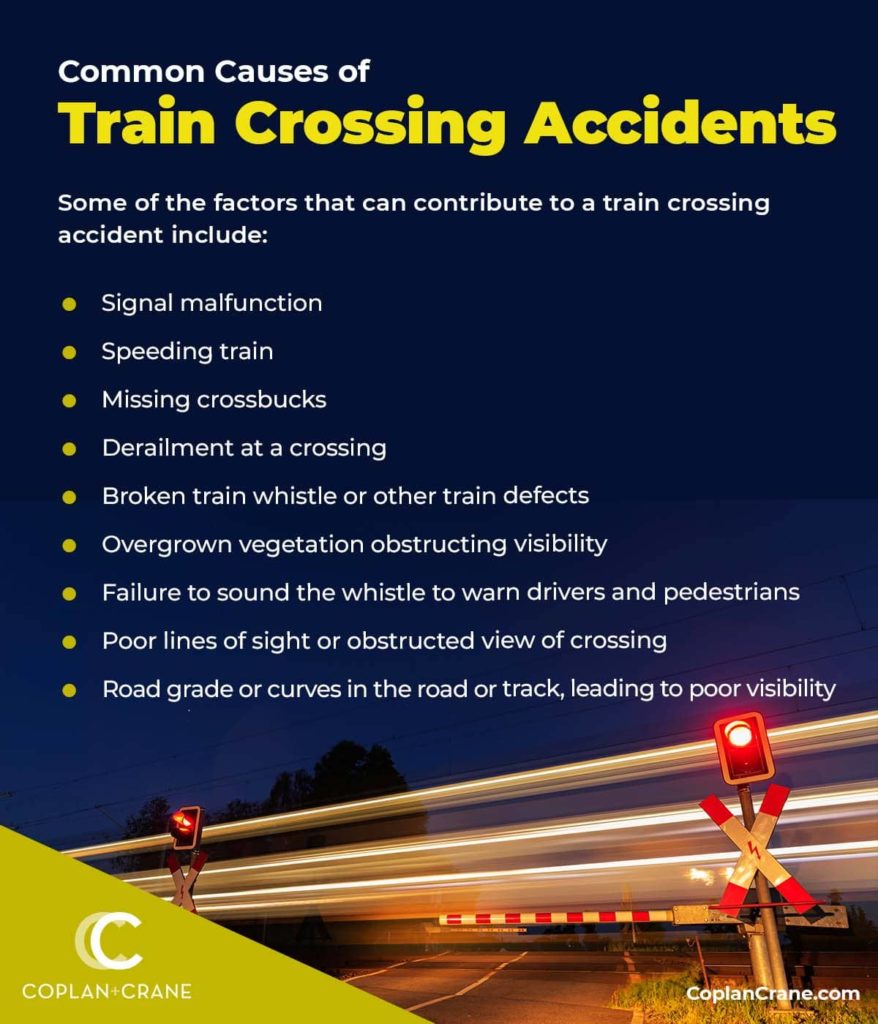
Some of the factors that may contribute to a crossing accident include:
- Overgrown vegetation obstructing visibility
- Failure to sound the whistle to warn drivers and pedestrians
- Broken train whistle or other train defects
- Missing crossbucks
- Signal malfunction
- Poor lines of sight or obstructed view of crossing
- Road grade or curves in the road or track, leading to poor visibility
- Speeding train
- Derailment at a crossing
Unfortunately, railroad crossing accidents can often be extremely complicated. Sometimes, the railroad tracks themselves can be owned by one company and the train itself can be owned by another company. Dealing with all these corporations and their teams of lawyers can be very confusing. One person might tell you one thing, while another person says something completely different.
What Should You Do After a Railroad Crossing Accident?
A railroad crossing accident can leave drivers, passengers, and pedestrians facing serious injuries and uncertainty about what comes next. The moments following a collision are often chaotic, but the actions you take can help protect both your health and your legal rights.
Because railroad crossing accidents frequently involve complex questions about crossing signals, warning devices, visibility, and railroad operations, preserving evidence is especially important.
If you are physically able to do so, consider taking the following steps after a railroad crossing accident:
- Call 911 and request emergency medical assistance.
- Seek medical treatment, even if your injuries do not appear serious right away.
- Photograph the crossing, including warning lights, crossing gates, signage, and visibility conditions.
- Obtain contact information from witnesses who saw the accident occur.
- Request a copy of the police report and any other incident documentation.
- Avoid discussing fault or providing detailed statements to railroad representatives before understanding your legal rights.
The circumstances surrounding railroad crossing accidents are often more complicated than they initially appear. Our Chicago train accident lawyers can investigate whether a railroad company, equipment manufacturer, government agency, or another party may have contributed to the accident and resulting injuries.
Derailment Accidents
Train derailment accidents in Chicago and throughout Illinois are not uncommon. As home to one of the nation’s largest railroad networks, reports of train derailments in Illinois happen far more often here than many other states.
If you’ve been injured in a train derailment accident in Illinois, you need an experienced Chicago railroad accident lawyer on your side, fighting for your rights. You need someone who understands the state’s complicated legal system and knows how to get you the compensation you rightfully deserve. You need Coplan + Crane.
We understand the serious nature of derailment accident injuries, which can range from broken bones to traumatic brain injury, spinal cord injury and even death. Too much is at stake to try and deal with the railroads, their claims adjusters or the insurance companies and the red tape on your own. We fight hard to get the compensation our clients need for their medical bills, loss of income, pain and suffering and other damages related to the accident.
Derailment accidents can happen for many reasons. Sometimes, the switches on the railroad tracks are not set properly. Other times, someone who works for a railroad company made a mistake or did not perform the necessary maintenance work. Whoever made the mistake needs to be held accountable. That’s what we do best – work hard to uncover the truth.
What Should You Do After a Train Derailment?
Train derailments are among the most serious railroad accidents and can result in catastrophic injuries for passengers, railroad workers, motorists, and nearby residents. In the aftermath of a derailment, your primary focus should be obtaining medical care and ensuring your safety. Once immediate concerns have been addressed, preserving information about the accident may become important.
If you were injured in a train derailment, consider:
- Seeking emergency medical treatment immediately.
- Following all instructions from first responders and emergency personnel.
- Documenting your injuries and recovery process.
- Preserving photographs, videos, and other evidence related to the derailment.
- Keeping copies of medical records and accident-related expenses.
- Avoiding discussions with insurance companies or claims representatives before understanding your legal rights.
Determining the cause of a derailment often requires a detailed investigation involving maintenance records, track conditions, equipment inspections, and railroad operations. Preserving evidence early can be critical when pursuing compensation after a derailment accident.
Who Can Bring a Railroad Accident Claim?
Many people assume railroad accident claims only involve railroad employees. In reality, a wide range of individuals may have legal grounds to pursue compensation after a train-related accident.
Depending on the circumstances, a railroad accident claim may be brought by:
- Railroad workers injured on the job through a FELA claim
- Commuter train passengers injured while riding, boarding, or exiting a train
- Metra passengers injured in train-related accidents
- CTA passengers injured due to negligence
- Drivers involved in railroad crossing collisions
- Passengers traveling in vehicles struck by trains
- Pedestrians injured at railroad crossings or train stations
- Families pursuing wrongful death claims after a fatal railroad accident
- Employees subjected to retaliation after reporting unsafe conditions through whistleblower claims
Every railroad accident is different, and determining whether you have a valid claim often requires a thorough review of the facts. An experienced railroad accident attorney can evaluate your situation and explain your legal options.
Who Can Be Held Liable for a Train Accident?
Determining liability in a railroad accident is often more complicated than it appears. Unlike many personal injury cases, multiple parties may share responsibility for the same accident.
Potentially liable parties may include:
- Railroad companies
- Train operators and engineers
- Commuter rail systems such as Metra
- Government agencies responsible for rail operations or maintenance
- Maintenance contractors
- Equipment manufacturers
- Signal and crossing system manufacturers
- Property owners responsible for hazardous conditions near railroad property
- Third-party contractors working on railroad infrastructure
For example, a railroad crossing accident may involve questions about crossing gate maintenance, signal malfunctions, vegetation obstructing visibility, train speed, and operator conduct. Because several parties may contribute to the same accident, identifying all responsible parties is often a critical step in maximizing compensation. A Chicago train accident attorney can help determine who may be responsible for your injuries and pursue compensation for your physical, financial, and emotional losses.
How Railroad Accident Claims Differ From Other Personal Injury Cases
Railroad accident claims are often significantly more complex than traditional personal injury cases. Many accidents involve unique federal regulations, specialized laws, and large corporations with substantial resources dedicated to defending claims.
Several factors can make railroad accident cases different:
- Federal laws such as the Federal Employers’ Liability Act (FELA)
- Regulations enforced by the Federal Railroad Administration (FRA)
- Multiple potentially liable parties
- Extensive accident investigations
- Complex maintenance and inspection records
- Government entities that may be involved in rail operations
- Large insurance policies and corporate legal teams
- Technical evidence related to train operations and railroad infrastructure
Railroad companies often begin investigating accidents immediately after they occur. As a result, preserving evidence and conducting an independent investigation can be essential. Working with an attorney familiar with railroad litigation can help ensure important evidence is identified and protected before it disappears.
How Much Is a Railroad Accident Claim Worth?
The financial and personal impact of a railroad accident can be substantial. Depending on the circumstances of the case, injured victims may be entitled to compensation for both economic and non-economic losses.
Compensation may include:
- Past and future medical expenses
- Rehabilitation and therapy costs
- Lost wages
- Loss of future earning capacity
- Pain and suffering
- Emotional distress
- Permanent disability
- Disfigurement
- Loss of enjoyment of life
- Wrongful death damages for surviving family members
The compensation available in a railroad accident case depends on many factors, including the severity of the injuries, the extent of financial losses, and the parties responsible for the accident. An experienced railroad accident lawyer can help evaluate the full value of a claim and pursue the compensation needed to support long-term recovery.
Talk to Our Chicago Train Accident Lawyers for FREE
Whether a railroad accident involves a commuter train, Metra train, or CTA ‘L’ train, the Chicago train accident lawyers at Coplan + Crane can help.
Contact us today online or at (312) 982-0588 to schedule a FREE case evaluation. Our Chicago train accident lawyers help clients across Illinois, including Chicago, Oak Park, Rockford, and other areas.